
Red Ivory would like to share this interesting article on Arabic calligraphy, created by the famous artist Raouf Meftah and written by the well-known journalist Dr. Monica Mergiu.
Arabic Calligraphy, a Jewel Across Civilizations
Arabic Calligraphy: written art
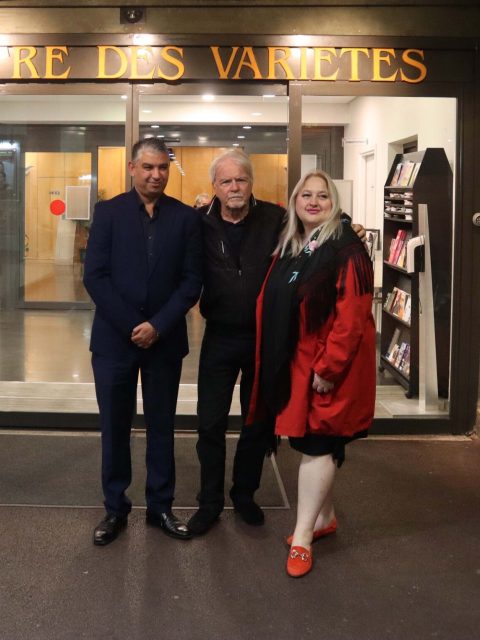
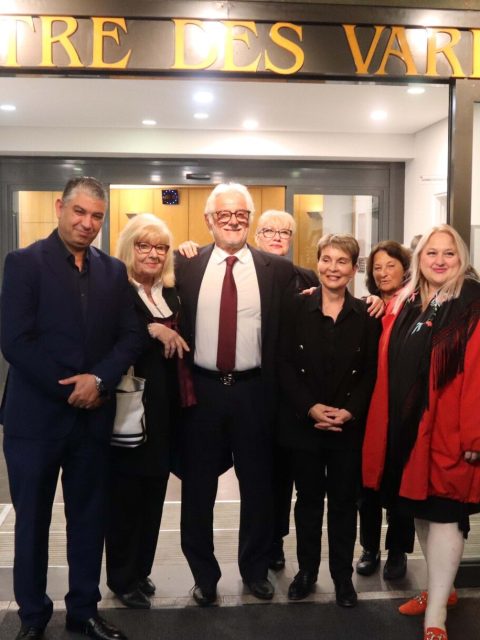
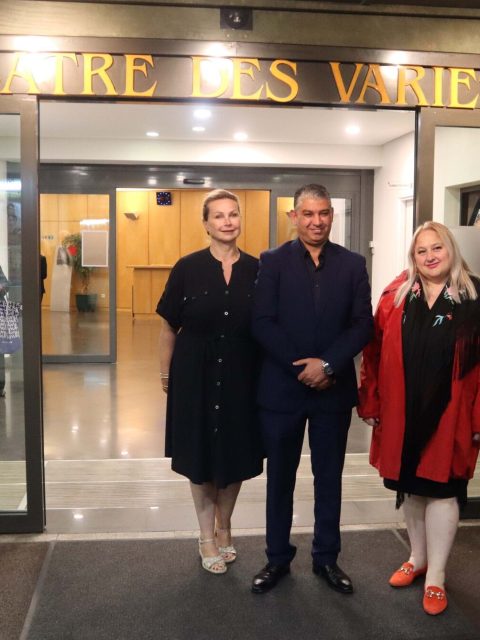
Conference by Raouf Meftah with Guest of Honor Dr. Monica Mergiu – Théâtre des Variétés, Monaco, October 2025
Beneath the golden dome of the Théâtre des Variétés in Monaco, letters became light.
On October 2, 2025, calligrapher Raouf Meftah and art historian Dr. Monica Mergiu offered the audience a rare dialogue: a meeting between gesture and thought, between the rigor of writing and the poetry of civilizations.
The conference, titled “Arabic Calligraphy: a Jewel Across Civilizations,” was organized by AIAP Monaco – UNESCO, bringing together art lovers, scholars, and the curious around a theme as ancient as it is fascinating: writing as a mirror of humanity.
That evening, Raouf Meftah invited the audience on a journey to the heart of the Arabic letter — a sign that becomes breath, a stroke that becomes prayer.
His conference resonated as a celebration of beauty in its purest expression: the gesture that unites the visible and the invisible.
The Royal Script of the World
Before ink flowed onto the canvas of words, Dr. Monica Mergiu, art historian and specialist of Middle Eastern royal courts, opened the session with a reflection on the place of calligraphy in the history of power and the sacred.
In Umayyad, Abbasid, and Ottoman palaces, she explained, the calligrapher was not merely a scribe: he was a guardian of beauty and a messenger of the divine.
Each stroke became a symbol of authority and harmony, each curve a reflection of celestial perfection.
She also highlighted the role of calligraphy in the dialogue between East and West, noting the influence of Arabic motifs on European decorative arts of the 15th century, and the enduring fascination contemporary designers feel for the fluidity of Arabic forms.
«In civilizations where the image of the divine could not be painted, the letter became face, breath, light.»
— Dr. Monica Mergiu
Her intervention reminded the audience that calligraphy has always been a language of majesty: the language of illuminated manuscripts, azure domes, and golden steles where the word embraced matter to speak of eternity.
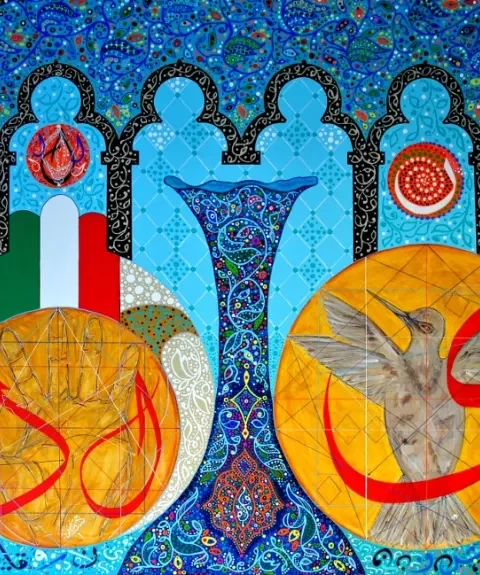
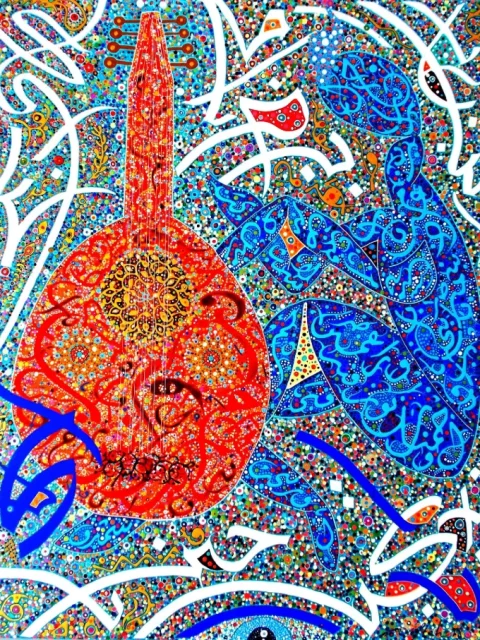
Raouf Meftah: Breath and Light
Then came Raouf Meftah, calligrapher and poet of the line.
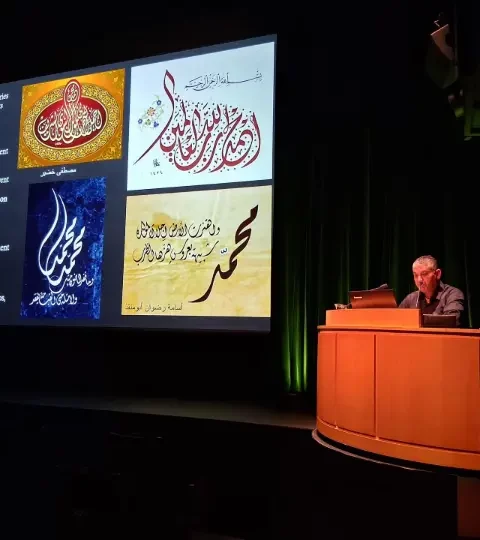
On the screen, letters danced, suspended like fragments of the soul.
From the rigor of Kufic, Thuluth, and Naskh to the soaring Diwani, he traced the transformation of an alphabet into an architecture of thought.
His discourse, imbued with spirituality, connected history with geometry, faith with proportion.
«To draw a letter,» he confided, «is to inscribe the invisible into light.»
Each form, he explained, obeys precise rules: proportions, balance, relation to the golden ratio.
Yet beyond calculation lies the heart — that silent pulse guiding the hand.
For Meftah, the letter is no longer a mere sign; it becomes living matter, a meditative space, a wave of silence.
«To draw a letter,» he said, «is to give shape to the world’s breath.»
His talk was accompanied by visual projections: arabesques, abstract compositions, letters floating in space like veils of light.
Meftah emphasized the universal nature of this art: calligraphy transcends language to become a shared symbol of beauty.
It is both science and spirituality, discipline and ecstasy.
Each stroke follows geometric rigor while carrying a mystical dimension: the calligrapher’s slow, meditative gesture connects humanity to the invisible.
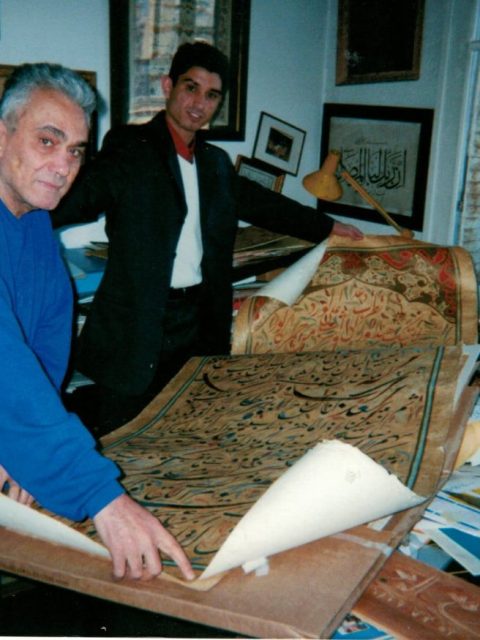
Between Tradition and Modernity
Faithful to tradition but looking to the future, Raouf Meftah advocates a calligraphy liberated from paper, free in canvas, metal, and light.
His contemporary compositions blend pigments, gilding, and abstract textures, reminding us that Arabic letters, far from being relics, are a living plastic energy in motion.
For him, modernity should not erase the ancestral gesture but amplify it.
He speaks passionately of young Arab artists reinventing this art on city walls, in fashion, and in digital design.
«Calligraphy belongs to no era. It is an eternal breath.»
«Calligraphy,» he confided, «is not read: it is felt.»
It is The Art of Writing.
The Art of Silence and Time
In the hall, the audience held its breath.
Each word of Meftah seemed suspended in the air, like a whispered prayer.
Calligraphy became a metaphor: for slowness in a hurried world, for contemplation in an image-saturated universe.
It is an art of time — long time, lived time, time that listens.
The artist reminds us that to draw a letter is an act of faith.
The hand follows the breath; the breath guides the line.
In this perfect tension between rigor and surrender, writing becomes music, invisible yet audible to those who know how to see.
A Universal Heritage
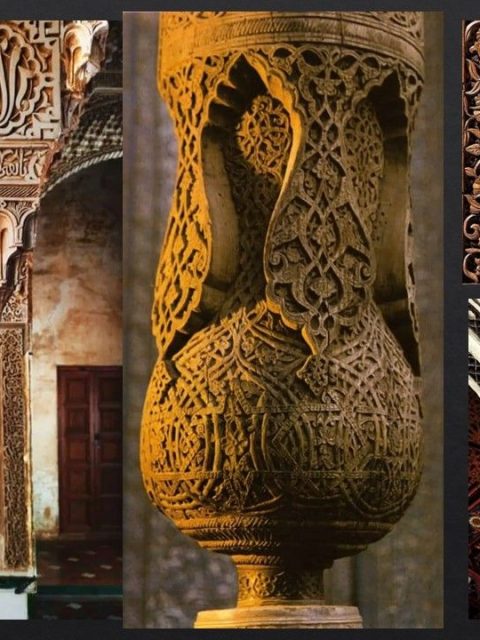
Since its inscription on UNESCO’s Intangible Cultural Heritage of Humanity in 2021, Arabic calligraphy has asserted itself as a shared heritage.
Yet beyond institutional recognition, Raouf Meftah emphasizes that it remains above all a spiritual legacy: an art that speaks to the soul, transcends borders, and invites meditation.
A living heritage
The event marked a significant historical moment.
This recognition underscores the importance of both preserving and reinventing it.
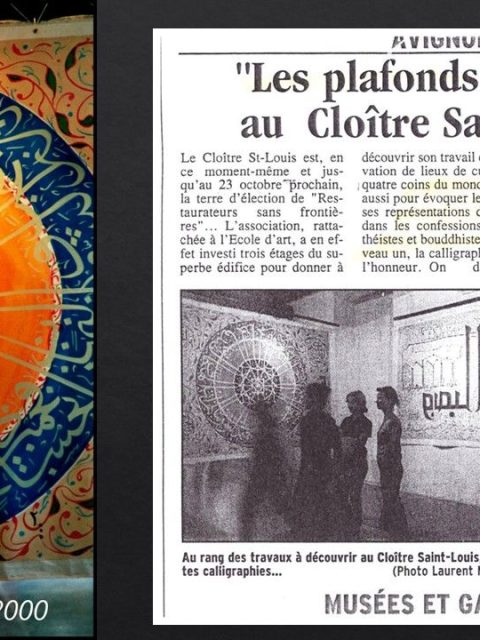
The exchanges between the two speakers highlighted a key idea: calligraphy is not frozen in the past; it remains a living language of the present, capable of speaking to the modern eye while carrying the memory of civilizations.
Epilogue
When the last images faded, a golden silence enveloped the hall.
Raouf Meftah, still absorbed in his letters of light, whispered:
«Every civilization left stones. We have left letters.»
In this phrase resonated the nobility of an art that, for centuries, has made eternity dance through the gesture of a hand.
In the theater’s silence, Meftah’s words echoed profoundly:
«Calligraphy is the breath of the word, the place where thought becomes light.»
And the audience, captivated, understood that this ancient art, far from being a relic, is a living energy, a bridge between cultures, a jewel polished uniquely by every civilization.
Raouf Meftah
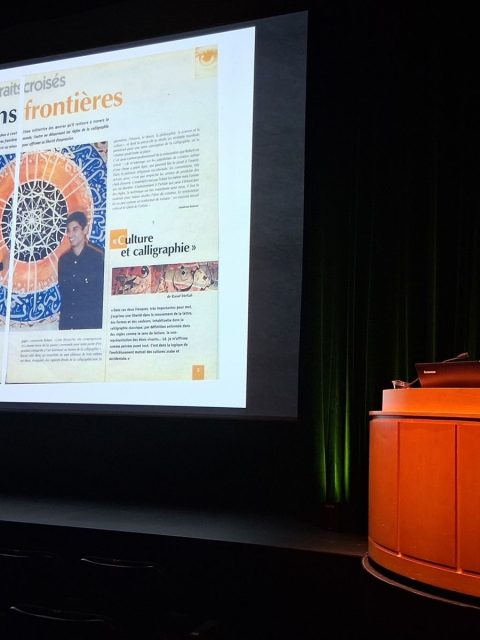
A Tunisian calligrapher born in 1976, Raouf Meftah is renowned for his works blending tradition and modernity. Trained in graphic arts and classical calligraphy, he exhibits worldwide—from Tunis to Dubai, from Bangkok to Monaco. His style combines Arabic letters and contemporary abstraction, inviting a spiritual interpretation of form and movement.
Dr. Monica Mergiu
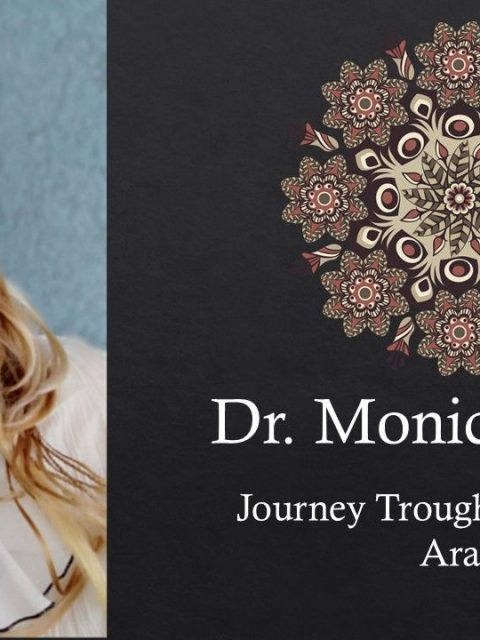
An art and cultural historian, she devotes her research to the role of art in the royal courts of the Middle East and Europe. The author of numerous books on cultural diplomacy, she advocates a humanist vision of art as a vehicle for dialogue between civilizations.