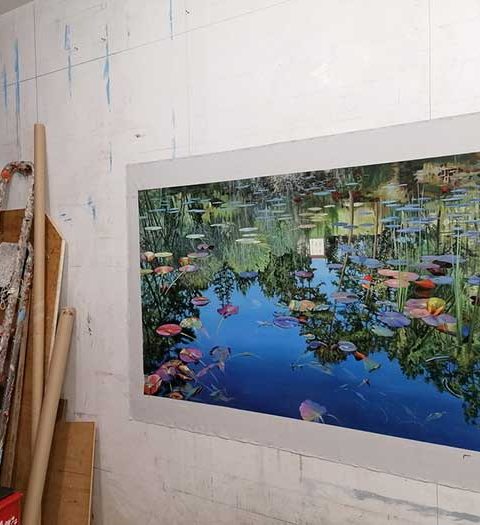
The art world is complex and has its own language that rigorously designates each of its elements.
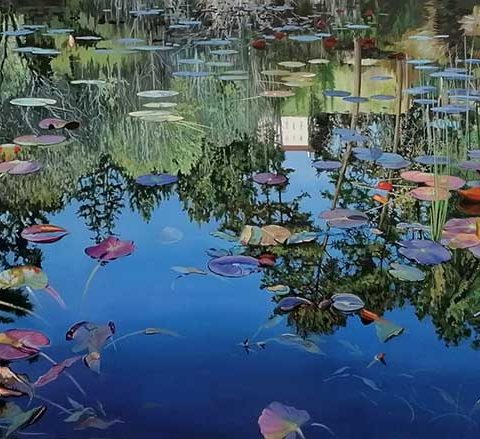
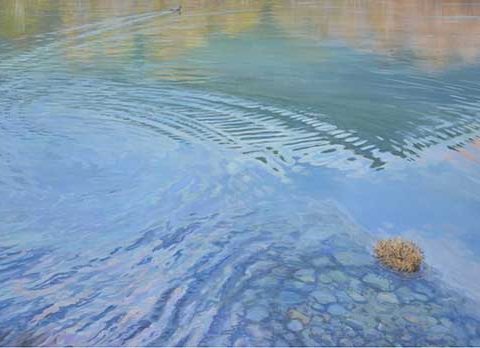
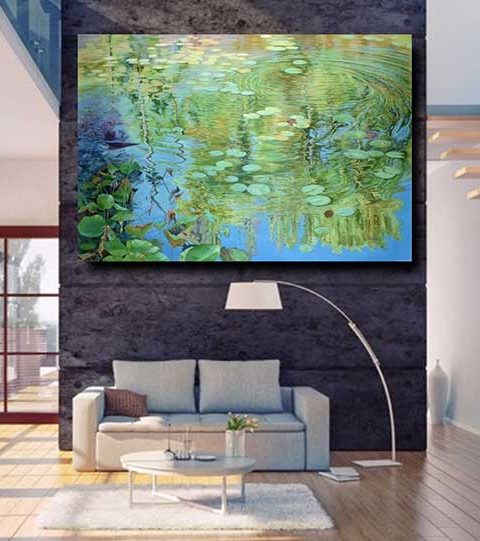
Today we open our blog to a French artist who paints great works through frescos and murals and who has achieved prestige and recognition for his good work.
Denis Bertau is, without a doubt, a great connoisseur of that art of times past that was painted on walls, ceilings and tiles.
Fresco is a mural painting technique that is done on a wet plaster surface. The word “fresco” comes from the Italian “affresco”, meaning ‘fresh’ or “wet”, full of vivid colors.
Mural refers to any type of painting or artwork that is painted directly on a wall or ceiling. Unlike fresco, murals do not have a specific technique and can be done with different materials, such as acrylic paint, oil, aerosol or even collage.
Denis Bertau lives and works in Paris. He obtains his Diploma in 1980 on Mural Art and in 1979, on First Ceiling, specialty in trompe l’oeil on walls and ceilings realized 1974 to 1978 ENSAD Paris, diploma in 1980, specialty in Mural Art 1979 First ceiling Specialties: trompe l’oeil decorations on walls and ceilings realized on canvas or in situ in France and abroad Technique: Acrylic for exterior decorations / Oil, casein, lime colors for interior decoration (colors realized in the workshop).
He has worked on, among others:
2016 Mercure Grenelle Paris Hotel, ST Cloud private residence, decoration for Atelier Tristant Auer, 2015 Participation in the creation of an exterior fresco.
2012-2014 Decoration of the private residence Riyadh, Saudi Arabia. 2011 Guest room, Le 6, Mandel, Paris.
2009 Holiday Inn Hotel, Paris. 2007 Office building, Paris, ceiling.
2006 Villa Marseille 2005 Hyatt Casablanca Hotel, trompe l’oeil 2003 Generali Restaurant, Paris, lime decoration 2002 Private Residence Cap d’Ail, lime decoration 2001 Private Residence, Cologne, ceiling decoration 2000 Riyadh Palace, Arabia, trompe l’oeil exterior decoration 1999 Riyadh Palace, Arabia, 7 roofs and panoramic views Hotel Pont Royal, Paris
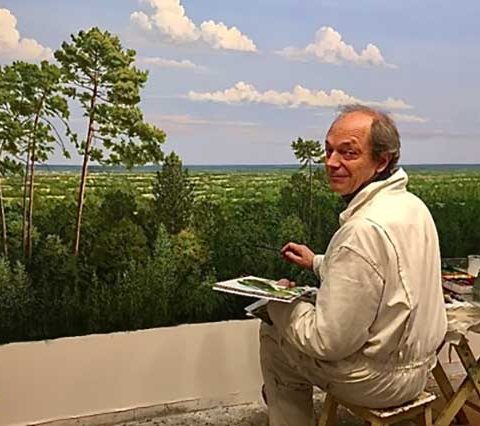
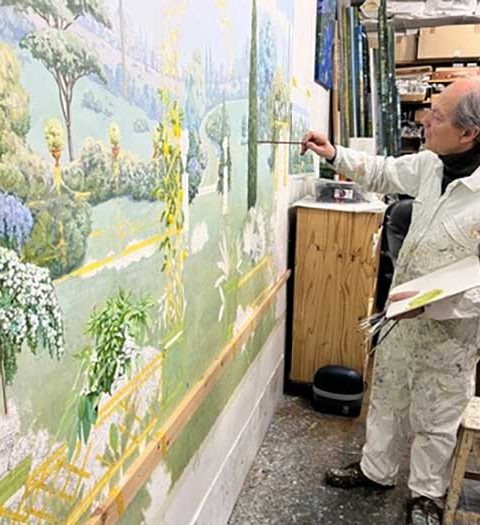
You are considered a fresco and tranpantograph artist, but how would you define that artistic capacity different from other oil and watercolor artists?
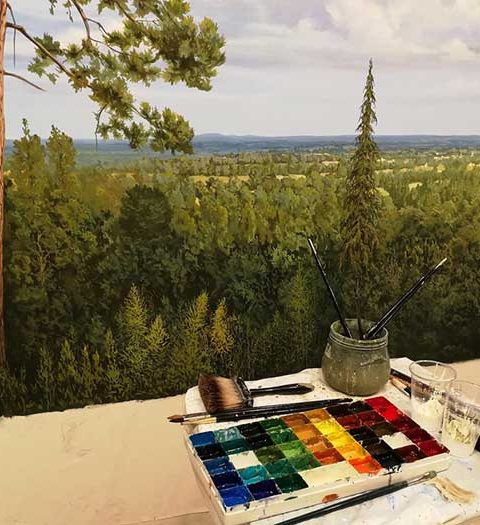
The main difference between mural painting and easel painting in oil or watercolor lies primarily in the dimensions of the support and also in the way the image is perceived, especially regarding perspective effects that call into question the materiality of the wall. The difference is even more significant for ceilings. Another difference concerns the techniques used. Although all can theoretically be used, wall decoration should favor matte finishes to avoid reflections and therefore preferably use water-based techniques with a finish similar to gouache.
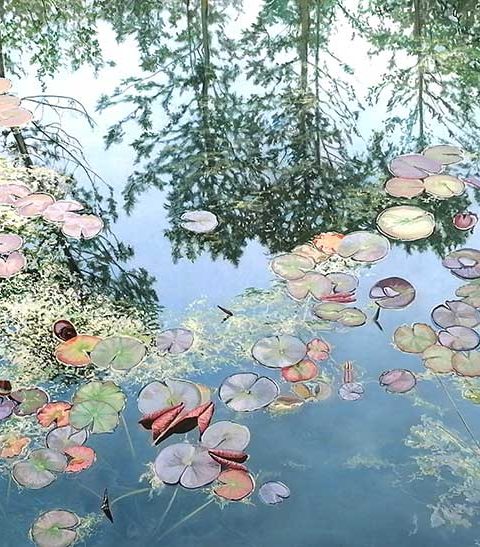
Your beginnings in the art world were more traditional. What did you learn from those techniques? Was there any artist that influenced you in your way of seeing art?
My choice to paint walls and ceilings stems from my final year at Arts Déco, specializing in Mural Art. I was passionate about working on large surfaces, from design to execution on scaffolding, with the goal of creating works that become an integral part of the buildings in which they are installed.
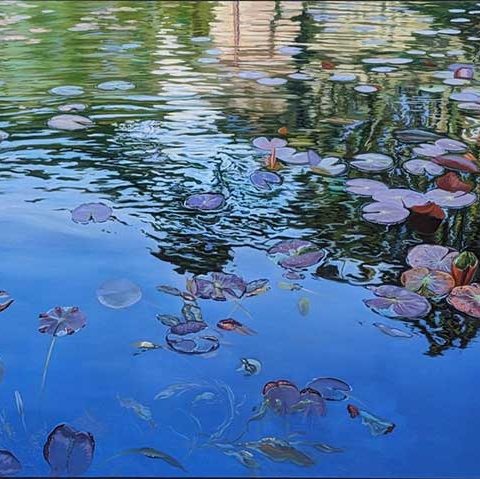
How do you plan each of your works?
Each set is a unique work created according to a client’s wishes in a specific location. Whenever possible, I travel to the site, both to take measurements and, more importantly, to understand the space and discuss it with the client on site, and generally a second time with the project on a smaller scale.
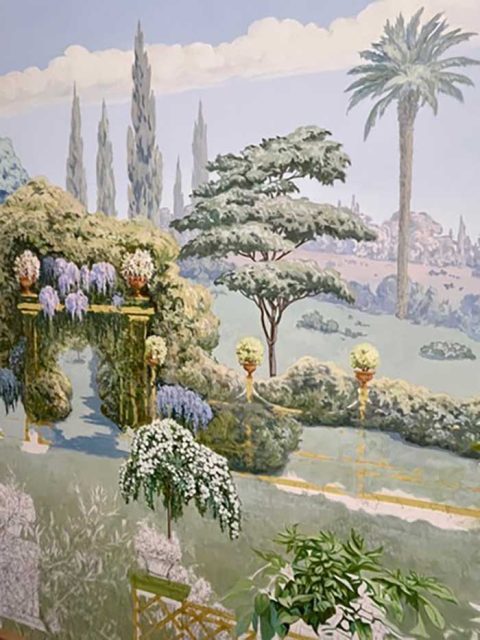
How can you make an exhibition with your kind of works?
I do not hold exhibitions of wall paintings, possibly with models and photos of the works, but easel paintings are naturally exhibited in galleries or other places.
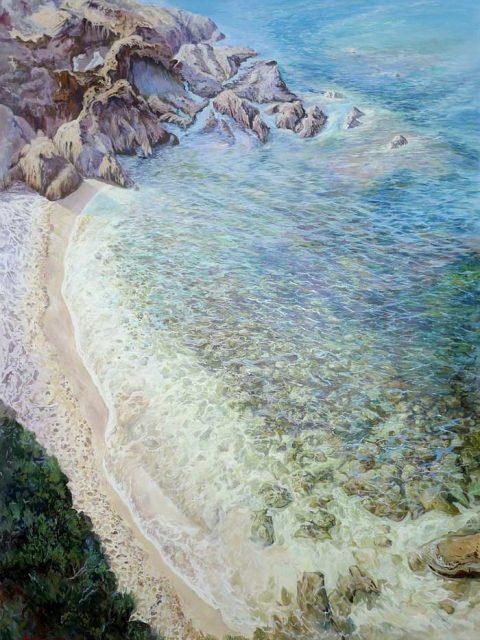
I suppose that each client asks you to personalize his painting for a specific place. Do you then move to the place of origin of that client?
The creation of a fresco is the culmination of a commission from a private or institutional client, with the approval of a model, which determines the budget. The planning of the work then depends on everyone’s availability, my own schedule, and also the preparation time for the paint I create and the materials I use specifically for overseas projects. When the dimensions of the decor allow for a canvas painting in the studio, the on-site work is limited to mounting.
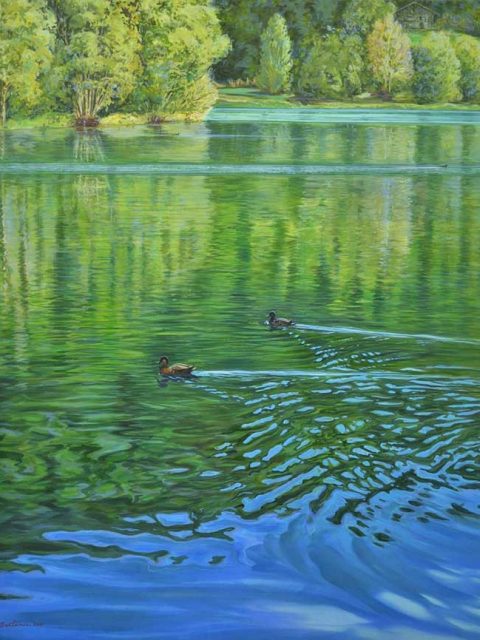
The ancient frescoes and murals have lasted for centuries. How is it possible that these magnificent works do not deteriorate in the open air?
Frescoes, or afresco paintings, are a painting technique on fresh lime and sand plaster. The pigments are fixed by the rising lime water, which, upon contact with atmospheric CO2, transforms into calcium carbonate, which is the fixative for pigments applied only when diluted with water.
Furthermore, lime only allows the use of certain pigments that are very lightfast, which explains the longevity but also the fragility of this technique, which I rarely used. It depends greatly on the qualities of the surface, but also on the environment, including water infiltration into walls or ceilings and impacts, especially in high-traffic areas.
What work would you like to do that you have not done yet?
Each new order is always something new, I let providence surprise me with a project that I have not yet completed.
Do you think that your type of technique and works are valued by art lovers?
Depending on the projects I carry out, I adapt my painting technique. With hindsight, some of the decorations that I can still see are more than 30 years old and are perfectly preserved and appreciated by their patrons. For the paintings on stretcher, the sales testify to the appreciation of collectors.
What are your plans for the future?
For the future, my main project is to continue painting as long as possible. For the immediate future, I have wallpaper design projects for major publishers.